

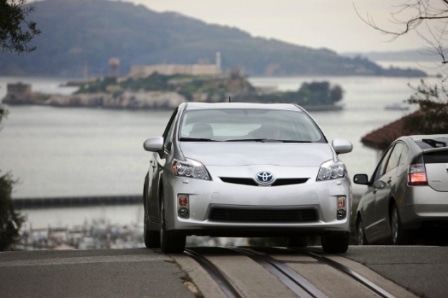
Dozens of owners of the current third generation Toyota Prius models have filled complaints with the National Highway Traffic Safety Administration about the alleged brake failures they have experienced.
The Office of Defects Investigation has at least 33 complaints that we are aware of from Prius owners alleging a problem or safety defect, often about the design or performance of the braking system, which recharges the battery when the Prius decelerates.
Some owners describe this as unintended acceleration, but a review of the complaints by TheDetroitBureau.com leads me to think that this is an issue about how the braking system is calibrated. Whether this is a safety related defect is ultimately up to NHTSA to decide. The safety agency is authorized to order manufacturers to recall and repair vehicles when ODI investigations indicate that they contain serious safety defects in their design, construction, or performance.
For Toyota, it is another owner satisfaction or quality issue, at a minimum, coming from its most advanced technology vehicle at a time when Toyota is under attack for its handling of safety matters.
Braking performance issues?
In the case of the Prius brakes, it appears that the transition from regenerative braking to hydraulic braking is not transparent to drivers. Under certain conditions, the driver needs to press harder on the brake pedal to obtain the same stopping performance that the regenerative system working in conjunction with the hydraulic brakes initially provides. Drivers are clearly upset by longer than expected stopping distances when the antilock system shuts off the regenerative brakes.

“What I, and others have been experiencing, is certainly not “runaway acceleration” or anything to do with pressing the gas pedal,” Robert Becker, an unhappy owner of a 2010 Prius, told TDB.
“But rather the loss of braking power or braking momentum when hitting a pothole, manhole cover, or the like. This requires the driver to press down again harder on the brakes to slow or stop the car,” Becker says.
Becker’s complaint is typical of others that ODI is tracking from owner communications on its Auto Safety Hotline. However, the existence of complaints does not mean the government will ultimately pursue the matter. The next steps would be to open up a preliminary investigation, which could be followed by an engineering analysis, which could lead to a recall. Neither have been initiated by NHTSA thus far.
Here is another Prius driver filing: “There have been several incidents in which my car seemed to surge forward while I was in the process of braking and hit a bump, railroad tracks or pothole. Initially, I convinced myself I must have been letting up on the brake when I hit the bump, but when this same thing happened three days ago on slippery, icy roads, I knew for 100% certain I had not let up on the brake. My car surged as I was slowly pulling up to a stop sign and gently braking. I came very close to hitting the car in front of me, had to push down on the brakes very hard, which activated the abs.”
I think what is going on is a combination of design/calibration choices and the compounding effects, forgive the pun, of the low rolling resistance tires, suspension settings and perhaps vehicle weight.
The Prius is arguably Toyota’s strongest image vehicle, dominating the hybrid segment as the best seller with more than 1 million in sales to date, and disproving other automakers’ contentions that Japanese companies only copied instead of innovating.
A Toyota spokesperson initially told TDB that he was unaware of the issue, but Toyota quickly supplied the following statement: “We are aware of the complaints filed with NHTSA. The agency has not opened an investigation. We are investigating the issue based on internet traffic, customer comments to Toyota Customer Relations, and NHTSA complaints. It is too early to speculate the final conclusion(s) of our investigation and subsequent actions.”
NHTSA would only confirm that no recall or formal investigation is underway. The ODI complaints are a matter of public record, though.
Fatal for Pedestrians?
Nonetheless, an internal NHTSA memo says: “It appears that when you hit a bump, the regenerative braking (front wheels only) cuts out, and there is a short delay until the friction braking kicks in. This results in loss of braking, which is experienced as acceleration (due to sudden end of deceleration from braking). Net impact is still a loss of braking/ increase in stopping distance. This could be fatal for pedestrians — it happens when approaching stop lights if you hit a pothole.”
Toyota is in the midst of huge recalls involving floor mats and accelerator pedals (3.8 million vehicles) and rusty Tundra frames (+100,000), among others; and it faces lawsuits alleging the withholding of evidence in safety investigations, as well as new charges of unintended acceleration, and stalling in some of its most popular models.
Toyota’s worst year for recalls, ever
So far this year, Toyota has said it will recall a total of 4.8 million vehicles in the United States, four times more than in any previous year. It recalled 1.1 million vehicles in 2004.
It is difficult, though, to attribute the Toyota brand sales decline in the U.S. – off 24% year-to-date, about the same as industry results — to a damaged reputation, in spite of much self-serving media and analyst commentary claiming such.
However, the longer safety and customer satisfaction matters remain under media and government scrutiny, the more serious the potential consequences. The company announced last week the retirement of its long time group vice president of environmental and public affairs, which could be coincidental or not.
The dealership that sold Becker the car recommended that a Toyota field technician check on his complaint. The technician, according to Becker, acknowledged the condition, but stopped short of characterizing it as a safety issue.
While he initially was looking for a fix for the problem, Becker now wants a full refund of the purchase price of the vehicle, something the company is unwilling to do thus far.
“It makes me question Toyota’s commitment to customer service and safety,” Becker says.


I first noticed this problem, not surprisingly, while driving in New York City and slowing down at a red light, approaching a pedestrian walk in Times Square. As I pushed down on the brake to gradually slow down, I must have hit one of the many potholes or bumps in the road, and to my surprise, instead of the car coming to a stop, it’s as if the brakes released unexpectedly, forcing me to press down harder to stop. I would guess that the unexpected forward momentum caused me to stop a few feet or more further than I anticipated. And when you’re talking about busy pedestrian walkways, you don’t have a lot of latitude before potentially winding up in the pedestrian walkway itself. The first time it happened to me, it scared the hell out of me – and that’s what many other Prius owners report as well. And it doesn’t take much of a bump in the road to re-create the occurrence. Now when it happens, I get angry more than anything else because I know this shouldn’t be happening!
Fortunately, I have not had an accident, but that’s due to my changing my driving style and anticipating when the braking issue will occur. I travel the same route back and forth to work each day and I have come to know many of the trigger points in the road that will create this issue – the scariest one being near a pedestrian crosswalk in New York where I have to come down a slight grade in the road before making a right turn – there are often pedestrians standing in the road itself, and of course, the road is bumpy there. What I have been doing to compensate for the brake issue is to switch from the “D” drive mode down to the lower gear “B” mode to slow down the car and avoid using the brakes when I don’t have to – in fact, whenever I am in need of slowing down the car on a decline, I will always switch into B mode to try to avoid using the brakes for as long as possible.
Interesting. I had the same symptoms on my ’96 Toyota T100 4×4 with ABS. I’d go over a bump or RR tracks while stopping, the brakes would release momentarily and I’d have to step on them harder to avoid rolling through a stop sign or hitting the car ahead of me.
I talked to the Toyota mechanic I bought it from used and he said he experienced the same thing.
I to have experienced this, there are actually a lot of these complaints on Priuschat. Many people have said that it is a regular occurrence with ABS brakes but I don’t think so, ABS brakes have been around a long time and I’ve never heard anything like it. I too have learned to slow down before bumps, cracks, tracks and the like. Sometimes you just can’t anticipate and the unintended acceleration happens. It really is very scary – it’s happened to us 3 times. Twice with no car in front of us and once when there was a car in front- thank goodness we don’t tail people. I hope this article brings to light the problem and I hope that Toyota takes this seriously. They denied the runaway accelerator problem until it couldn’t be swept under the carpet anymore.
Toyotas are no longer as reliable as they used to be with massive recalls and a new found mentality to hid safety concerns from the public. Refer to the LA Times recent article “Toyota found to keep a tight lid on potential safety problems”
People on this website please google search ‘2010 Prius accelerates while braking’. The 1st listing is titled ‘Prius sudden acceleration: Much ado about nothing’. Click on that site and read. There are more people experiencing this problem. We just all need to get together and get the NHTSA involved.They will do the rest. As I stated in a letter on the other site: you are very naive to think that Toyota will do anything about this unless forced to do so. KEEP COMPLAINING!! to your dealers also and keep the documentation.This will get media attention soon if we are all diligent with follow through.
It appears that the Japanese no longer feel they have dishonored their company when there is poor workmanship. My feelings on this come from the defects of which they do not want to acknowledge. Whether it was engineering, or tradesmanship, they still need to acknowledge their defects. That is the main reason I chose to buy a Toyota 2010 Prius III. (I knew that they considered it an honor to create a perfect product and had a feeling of failure if they didn’t. I felt safer with a Japanese made automobile).
My FJ cruiser has the same brake failure – but I was told by the dealer that it is normal, and in fact a ‘feature’ of the Electronic Brake-force Distribution system. Anytime I come up to an intersection, I hope there are no potholes or waves in the pavement, because I am not able to stop. I always try to brake way ahead of an intersection, just in case.
The worst thing about all these problems is that Toyota doesn’t even care. Toyota keeps making low-quality and sometimes dangerous cars and the American public keep handing them bundles of cash, which is all Toyota seems to care about anymore.
I have now had about 6 instances of my 2007 Prius feeling like it is out of control when I have put on the brakes at a lower speed approaching a stop or yield. I HAVE pressed hard on the brake as it scares me, but it seems to roll on. And yes, I have noticed it happening on manhole covers and in all types of weather. took it to the dealership and they told me one wheel may be slipping.
I have it back again to the dealership after yet another incident, as I am arguing it is a serious safety issue that makes my driving unreliable. They can find nothing as it is an intermittent problem. I have also argued that my mileage is several standard deviations from the “norm” they advertise but that is another issue.
No more Toyotas for me yet I will say that the 2003 Camry was one of the nicest cars I have had.
I have a 2008 Prius. On Dec. 17, 2009 I was in bumper to bumper traffic. I was about 2 car links behind the car in front of me. I took my foot off the brake to move up and my Prius surged forward. I tried to brake and literally stood on my brakes to stop. The only way to stop my car was to hit the car in front of me to stop it. The brakes would NOT engage to stop or even slow down my vehicle. I had no control of my car other than steering. I had the car towed to the dealership because I couldn’t drive it with no brakes. The dealership said they ran diagnostics on the brakes and there was ample brake pads and that they checked out according to specifications.
I KNOW what I experienced and it was not my fault that I hit the car in front of me. I had up to now clean driving record. Now, after this incident, I’m no longer confident it is a safe car to drive with this defect looming. I sincerely pray that the NHTSA will get involved before others are seriously harmed or killed by this problem with the brakes, accelerator, or surging battery issue on the Prius.
Good Morning Ken: Interesting one — ‘allaboutprius.com’ is the other site where I was posting. I don’t know who they are but I have twice written on that site for people with this problem to go to your site. Twice I have gotten off line and then online to verify the post and the comments have been there. Hours later they are gone….Have I hit a sore spot? I hope so!
I am not rude with my comments. I am simply zealous with my pursuit for an answer. My daughter owns one.
Thanks Len
I have experienced this many times on the bumpy roads of metro-Detroit. It is scary as you do not expect this to happen while braking…. I have driven many types of cars with ABS and never run across this condition. If not for the Internet forums, I would have thought of this as a defect. It just seems to be part of owning/driving a gen 3 Prius. Of course I would be happy if a fix can be developed that does not compromise the regen capacity of the brakes.
Wow, there’s a lot of irrational Toyota hatred going on here! It seems there’s a bit of mass hysteria in the air, and the reference by JCC to a LA Times article is laughable. The Times is just phishing for sensationalist articles in a period of declining readership.
But please allow me to recount my experiences with a 2010 Prius.
First, the blending of the electrical regenerative braking system with the conventional hydraulic disks is smooth and seamless. Under normal conditions the transition is not noticeable. The problem occurs when the brakes are applied and for one reason or another, the front wheels loose traction. In a conventional vehicle the brakes are applied on all four wheels, but regenerative braking on the Prius occurs only on the front wheels. So when the system senses a loss of traction it quickly shuts down to prevent an uncontrollable skid from developing. At the same time it activates the conventional hydraulic disk brake system on all four wheels, a transition that takes less than half a second, in my experience. The slowing forces being interrupted for this fraction of a second “feels” like an acceleration.
This “feeling” is consistent, in my experience, with other ABS anti-skid systems. If Toyota were to modify the system by turning off the anti-skid function they’d be blasted and sued for selling unsafe vehicles. If they disabled the regenerative braking system to make a few people happy under edge-cases, it would make me, and many others, very unhappy!
Still, this is only my opinion. If independent product testing shows there really is a significant safety issue, then it should be addressed. I don’t think there is.
In general I love my new Prius. However, the first time I drove it on snow I noticed that the brakes locked up when I applied only light pressure. This happened at a slippery intersection and caused a lot of panic. The car seemed to just slide straight forward. This is not some minor issue, but the kind of defect that gets people killed. I told my wife the first time it happened that we would be hearing about it in the media before too long. What are we Michigan Prius owners supposed to do now? Park our cars until spring?
Thank you Lewie! I have been asking on different websites if this is an increase in engine rpms or the sensation of acceleration,with no reply. It does take someone with mechanical knowledge to know the difference.If you are sure of this, it seems to be as stated earlier at this site, an interaction between normal brakes,antilock brakes, and regenerative braking. I hope this can be alleviated with a software change. I know a few people that say they have dealt with the panic of antilock brakes, but this is different. It is much more pronounced. We’ll see
I just read the article on the Toyota Prius brakes having an issue. I own a 2008 Prius. I have also a few times had the same sensation, of the brake slipping or not engaging. It happens on sand or, perhaps water, as best I can tell. The first time it happened it was very scary. I haven’t had an accident, but it isn’t only with the 2010 Prius that this type of problem occured. BK
Len: The engine definitely doesn’t increase RPM, it’s not even spinning in this braking situation! But to the best of my knowledge, the Hybrid drive isn’t providing electrical torque either. The vehicle isn’t accelerating, there’s only the “sensation” of acceleration. I know of one stretch of road that triggers the effect and I’ve navigated it multiple times just to figure out what was going on. The effect could probably be mimicked in a non-Prius by smoothly braking from 50-mph, but as you decelerate through 30-mph release the brake pedal for half a second or so. I bet a passenger wouldn’t be able to tell the difference between just releasing the brakes and actually accelerating.
Regarding Ken’s slipping observation: The Prius is supposed to have a vehicle control system that won’t let you get into a skid. If you “were” skidding, maybe the conditions were so bad that nothing would help? Or, is something wrong with your car? I saw some videos where a driver was trying to get a Prius to spin out on a snow-covered parking lot. They weren’t able to do it!
Lewie: I can’t detect anything wrong with the car except the slipping problem with light brake pressure. That’s the odd thing. My stops were not of the “panic” variety but were the kind of braking one does to stop in a controlled fashion on very icy surfaces (very common around here during or after snowfalls at intersections). I’ve driven many makes and models of car through the years without experiencing anything like this.
I have a 2010 Prius which, except for the braking problem, I love. I have had the experience several times described in the internal NHTSA memo: “It appears that when you hit a bump, the regenerative braking (front wheels only) cuts out, and there is a short delay until the friction braking kicks in. This results in loss of braking, which is experienced as acceleration (due to sudden end of deceleration from braking).” Thus far, this has never happened to me when I have been at an intersection where there are pedestrians crossing. But the feeling of being “airborne” and having a loss of control is frightening, and I have worried that it could cause me to ram into a car (or person) in front of me.
I have a 2010 Prius. I’ve experienced this problem about half a dozen times while decelerating / braking. When the car hits a bump, it feels like the braking pressure goes to 0, which gives me the sensation of the car lurching forward. I’d imagine the chance of something catastrophic happening are probably pretty low, but this is probably a legit safety issue. I’ve filed a complaint with the NHTSA. We’ll see where this goes, if anywhere at all.
I have been anxiously awaiting the date (May 1st, 2010) when I have planned to officially purchase my FIRST Toyota. I had all plans to purchase a ’10 Prius – but now I am a little reluctant and hesitant to do so. Hopefully Toyota and NHTSA will take care of this for all current and future Prius owners.
Hi, Meg,
I hope you are right. Would I not recommend a Prius now? If someone were convinced it was the right vehicle for them I might say, “Go for it.” But considering the number of complaints, I might advise hanging tight to see what happens. Be aware that so far, none of the reports and complaints suggest the braking issue has had the sort of impact as the loose floor mats have had on Toyota product safety. Nonetheless, it’s disconcerting to hear that a vehicle could lose its brakes, even for a moment, and then try to justify a buy recommendation. Let’s see if and how Toyota responds. Indeed, the feds may decide that there really is no problem, though at this point, that seems questionable.
Paul A. Eisenstein
I like the comments about Toyota not being as reliable now…
I doubt they ever were as reliable as the media played them out to be. Ford/GM/Chrysler issues were always front page. Toyota made page 13. Times are finally changing.
I spent seven years as a quality engineer working for a Toyota keiretsu supplier. The stories I have could provide a few book volumes…
Let the American sheep keep buying their perfect little imports…while they lose their houses due to the failing economy.
Smart.
Reliability infers time. These are messing up out of the box. I do have to agree we are sheep to the media. I personally have owned both American & foreign cars throughout my life including an Audi 5000 (sudden acceleration sound familiar?!). Other than design flaws, which we are discussing here, I have found that the reliability of an automobile is in how you maintain it. If Detroit wants to sell more cars, make them look good and be fuel efficient. It’s always been that,in order to be priced moderately, it has to look ridiculous. Course I’m in conflict with myself on this one cuz lately UGLY sells too. I’m suddenly tired!. Need to get back to Prius braking problem!!
You should NEVER buy a car in the first few years of its debut. There are ALWAYS problems.
Prius’s sold like crazy when gas was $5/gal, Then the price of gas dropped to $3/gal. Abiding by the above rule would also prevent folks from paying extra for a hybrid when gas prices were ready to fall anyway. No need for a hybrid.
I am sure Toyota will get the bugs out. For present owners, you are screwed.
Vito
I have a Prius 2010 Prius and it happens everyday for me. I live on a hill, and driving down it is a speed bump. Every time I go down, I keep my foot gently pressed on the brake, but when I ride over the speed bump, I loose braking tension and for a good second I accelerate instead of maintaining my intended speed.
Hey Folks,
The reason the car does this is to maintain vehicle stability. The vehicle will switch from a regenerative braking / hydraulic braking combo to pure hydraulic braking if it detects a significant change in one of its many accelerometer sensors (which would be triggered by a manhole or any other similar obstacles on the road like a pothole). My understanding is that this is actually a safety feature to help prevent the Prius from fishtailing or otherwise careening out of control. I suppose Toyota could have made it so that the switch from regenerative braking to pure hydraulic braking was more forceful…but there are probably standards for that sort of thing that they have to comply with.
Andrew
To all trying to find fault with the Prius just because it has engineering you don’t understand I would like to say that I have experience this phenomenon in many modern cars its not unique to the Prius.
With the built in stability systems of today’s cars we have become lulled into a false sense of security driving beyond the limits of adhesion.When the systems react we think its the fault of the car when in fact its the drivers fault.Late braking,slippery conditions,uneven road surface’s will bring these system’s into play indicating the driver is not aware of the danger.
Every incident from this article mentions conditions such as late braking,hitting bumps,or slippery conditions which would indicate ABS kick in. There is no way regen braking is involved, the drag is so slight and even negligible at low speeds its undetectable when it drops out. The hydraulic brakes are always there from high speed to full stop but if ABS is activated the wheels are allowed to cycle between rotating and stopping thus increasing the stopping distance. This produces the sensation the car is not going to stop no matter how hard the pedal is pressed.
I suggest these owners Google ABS brake characteristics and stop spreading misinformation.
I’ve been dreaming about Toyota Prius 2010 to come – to buy one. Yes, because Prius has finally become a normal car, because of its fuel efficiency and the technology packages available. But, there is nothing more important than safety!
Now, I can with certain confidence say:
I WILL NOT BUY THIS CAR BEFORE THE PROBLEM HAS BEEN RESOLVED.
Yes Alexander I would suggest not getting out of bed you might be safer there.
If you will read my comment above and stop listening to those trying to harm sales of Hybrids you might realize its not the Prius thats at fault.
Any modern car has these traits and its down to the characteristics of the modern ABS systems.
Drivers are also at fault as described above.
I drove a 1st generation Prius for 7 years with this exact problem. I complained to the Toyota dealer but they said that was how the braking system was designed. I have since driven two other cars over the same manholes, rough roads under construction etc and have not had any problems. I know from experience that my stopping distance is extended by a few feet in these instances and it is a safety issue. In the real world I adjusted my driving style to be even more defensive. In all other aspects I believe the Prius to be a good car but I chose not to buy another one mostly for this reason.
I own a 2010 Prius and have driven other cars with ABS and currently ride a 2002 BMW R1150RT motorcycle with ABS that I purchased 6 years ago. I have experienced the feeling of loss of braking the MOST on the motorcycle at very slow speed over very sandy, rocky and/or bumpy road conditions, much more so than in my Prius, and I have never had an accident because of it.
While it is true that the Prius’ loss of deceleration is more than most other ABS equipped CARS, my bike has the scariest loss of braking by far (but it has always been at very slow speed so it never scared me enough to part with it). I have noticed that I give a progressive increase in pressure on the pedal while braking in the Prius (as opposed to a steady pressure on the brake pedal in other cars) to compensate for the increase in stopping distance that I have perceived while braking.
But, I have never experienced an ACCELERATION as some people have been stating. I also have noticed that it is also more common at slower speeds, or more precisely, as the car is approaching slower speed while braking. I have put over 43,000 miles on the bike (often in rainy or less than optimal riding conditions) and I’m still here.
I would definitely buy another Prius. In my opinion, the brakes on the Prius are weird at most. Aside from the one person who posted here that rear-ended someone in bumper to bumper traffic, there doesn’t seem to be a lot of statistical data to support an all out recall. Seems to me people just need to adjust to the car.
Yep! It has happended to me and it is not fun. Need a fix…
RGL
This has happened to me several times in my 2010 Prius. I’ve nearly hit cars while turning into parking lots after driving over a bump. Also have rolled into intersections because of potholes and lack of braking power. Anyone who says it isn’t a safety issue is silly. I’ll be filing my official complaint ASAP. Someone’s going to get hurt. Roll out into a major intersection and splat!
Wow you guys are really on to something, with over two million worldwide sales of the Prius this perceived problem has only cropped up with a handfull of American drivers.
Strange,strange, strange.
Thoughts of conspiracy,our willingness to sue,paranoid safety freaks,enginering ignorance,bad driving all spring to mind.
My brakes have not failed. However, I do believe the Prius has a problem with their brakes.
My car started making some strange sounds. The dealer first drained all the brake fluid to check for air in the lines. When that didn’t fix the sounds, they replaced the actuator assembly which corrected the initial strange sounds, but ended up creating many more unusual sounds that were not previously there. The brakes work but sound like they are slipping and all sorts of clunking sounds are now occurring when the brake pedal is depressed which gives one a very uneasy feeling.
The dealer insists that all of the sounds are normal but they definitely were not there before. Also, since they replaced the actuator, my gas mileage has dropped about ten per cent.
I do know that they dropped power completely when they replaced the actuator but it doesn’t seem like that should reduce the gas mileage.
Anyway, I had been thrilled with my Prius for the first 21 months but I am now extremely disappointed in it and it is not a pleasant vehicle to drive. It also makes me constantly wonder if the brakes are going to fail.
I’ve complained to Toyota headquarters but they have not been any help.
One of the problems with a Prius is that only a dealer can work on them.
If these strange sounds continue, I will trade my Prius in on either a Ford or Chevy, something that almost any independent garage can work on.
Throughout this and other comments on other Web sites and blogs about this issue, there has been a lot of talk of conspiracy, paranoia, lack of driving experience, poor road conditions, etc. I can assure folks that this braking issue is about nothing more than trying to address a potential safety issue with the car and the need to generate awareness on it to get it resolved one way or another. Why there is debate and/or defensiveness about this issue is beyond my understanding.
Robert: I think D Gate is a Toyota dealer.
To all that post here: I’ll say it again.I owned an 85 Audi 5000. Both my wife and myself almost went through the garage wall. We got the same “can’t find any problem” crap from the dealer and Audi vehemently denied the problem. It took 60 Minutes to bring this out to the public. Then it got fixed.
That was a real acceleration problem. The Prius HAS a problem with the braking system.It may just need to be sequenced better for the weight of the vehicle.But as long as people keep complaining and ignore the “it must be the way you drive” excuse from the dealers, this will eventually this will get media attention it deserves.
Devil’s advocate:After all is said about this. I HATE antilock braking systems! I’m an old fart. I’ve driven for 40 years in the winter without anti-locks and I’m still alive. The reason we have all this technology to help people avoid accidents is because most people are lousy drivers.
If you want to talk conspiracy,let’s say that after years of telling people not to tailgate, the automakers came up with anti-lock brakes to scare the @#$% out of us. ‘A few panic sensations of never stopping will teach em a lesson’!
No I am not a Toyota dealer and I agree if there is a problem it needs to be sorted.
What gets my dander up is certain peoples attitude toward the car just because its different.
Suddenly its the hybrid system,or the lighter weight,or Toyota as a company.
No ladies and gentlemen its life,nothing is perfect and this imperfection is spread through out the industry whether its Ford or Chevy,BMW or Mercedes.
They all have problems.
Adopting an attitude like I’ll never own another Prius,or my next will be a chevy etc just because there is a problem with one in 10,000 is childish. Dealers are not always proficient whether they are GM,Ford,BMW,or Toyota at finding a solution. And as Tjw above has found out they can introduce new problems trying to solve existing ones.
The Prius is a GEM so don’t be so shallow in your support of it just get it sorted even if you have to travel to other dealer’s. Would you take the word of one doctor in a no hope case?
I have driven Hybrids for the last ten years and if I had a major problem I wouldn’t condemn the technology it would be the particular car. My solution would be to get it sorted or change to another car of the same type not whine and give the make a bad name.
For a few years,Toyota Hybrid System’s problem like this was reported by the Japanese customers on the owner’s BBS of ex-PRIUS and ESTIMA HYBRID and so on. So Toyota’s engineers must know this problem. But they didn’t fix the system because of the saving of the development cost or technical problem. I think the new PRIUS was designed more mileage intention and raised the dependence of regenerative braking. As a result,the phenomenon became more serious.
D Gate: I agree. My daughter owns a 2010 Prius and loves it, other than this issue. I owned that Audi and it was the nicest handling car I ever owned.
Unfortunately, because of liability issues, everything about problems like this are always hush-hush. It leaves the consumer with a feeling of abandonment. That intern festers all of the anger that we’re reading.
The dealers and the manufacturers (and the lawyers)need to find a compromise that leaves the consumer with a sense that problems are at least being addressed. That’s a fine line in our litigious society.
Now that I know your stand, I apologize for my previous comment to your previous statement.
Friends??
Len I have been called worse so don,t fret…
However pyro thinks Toyota doesn’t sort it out due to revelopement costs????
Logic tells me this car has probably had more money spent on it in developement than any other in history so why would they call a halt to further spending if its reputation were at stake.
The mind boggles!
I traded my 2005 Prius for my current 2009 Prius (well over 100,000 combined miles). I have experienced this strange braking phenomenon a few times with both models, but never to the point of feeling unsafe. Every car has its own driving characteristics and you adapt accordingly. It took a little while to adjust to the gearshift lever being on the dashboard, now one of the reasons I did not trade for a 2010 Prius is because the gearshift lever is NOT on the dashboard. If people would learn the little oddities of the Prius, they would find there really isn’t a real problem with the brakes.
Owner of a Prius 3 since Nov. 09, I NEVER have experienced that phenomenon.
Prius was running still 12 years. Which other manufacturer has more experience with HSD system ? Chevy ? I don’t think so !
I wish that it is about a storm in water glass.
We’re getting there! I just googled “2010 Prius acceleration while braking” The 1st website posted is about the NHTSA now looking into complaints from 3rd generation Prius owners about this issue.
As much as I am an old fart and am not a big fan of computer over-use, the internet surely brings people together on issues like this. So as much as it is contrary to my nature; KEEP POSTING!!
My gosh – people – ANY car with ABS exhibits this – when you hit a bump the wheel momentarily stops and makes the ABS system think the vehicle is sliding – there is a momentarily delay as the ABS system initializes and lets off the brakes to stop the perceived skid. I’ve had this on all my cars since I first got ABS in 1992.
The world is full of ignorant drivers, prius divers are no exception – there should be a public education campaign on how to drive a car with ABS.
This is a NON news item – move along!
I have a 3rd gen and I can confirm this happens when you brake over uneven ground. It isn’t a surge of acceleration but rather a loss of braking that occurs. Some people are claiming that it is a characteristic of ABS. What is going on isn’t what should be expected from ABS kicking in. I have owned several cars over the years that have ABS and none of them have behaved in this manner. This is my first Toyota (first Prius, first hybrid, etc). I don’t expect this to be the way the car should behave. If it is or if Toyota refuses to address it, it will be the last Toyota I own and I will trade it in before it is due time.
I think the car is a great piece of technology but this is an issue that really needs to be looked at.
Does anyone here know how many complaints the NHTSA needs to accumulate, before they decide to start an investigation? How long does such an investigation take to complete?
(I was going to buy a new Prius, took a test drive, felt something weird while braking, then google found me this page which describes exactly what I experienced)
There doesn’t have to be any number.
I agree with Ken 1/9/10. I’ve had other cars with ABS and they all behaved in the same way, split second loss of braking while ABS detects wheel lock. My motorcycle does the same thing. You just have to push on the brake pedal harder. The Prius’ brakes are very consistent. I’ve been driving to work in New York over the past month in terribly cold, snowy, icy weather over roads that became crappy from overzealous snowplow truck drivers who should have just put salt down instead of tearing them up when there was less than half an inch of snow. I have yet to feel unsafe in my car. These people who think there is a problem have either a rarely occuring defect in manufacturing, or more likely expect too much out of a system that incorporates ABS, hydrolic-mechanical, and electro-regenerative braking. They should probably just trade in their cars and buy SUV’s so that they can finally quit crying and start to feel safe (just hope they don’t flip over).
I have no complaint with the way the ABS brakes worked on my Prius, although I have to admit that under certain circumstances, they do give a little bit more of an “out of control” feeling than I have experienced with other ABS brake systems (in several Lexus models and also a Silverado pickup and a Tundra pickup).
My complaint about the brakes in my Prius concerns all the strange sounds that come out of my Prius’s braking system after the Toyota dealer replaced the actuator assembly.
I’ve now taken my Prius to a second Toyota dealer. Unlike the first Toyota dealer, the second dealership readily agrees that the sounds are not at all normal. However, they have had my car for several days and say that they are so far unable to correct the problem and that they suspect the braking repair instructions from Toyota in their manuals may be incorrect. They said they were trying to get help from Toyota headquarters but that they were having difficulty getting help because all the Toyota support people are very involved in the sticking accelerator problem.
Anyway, my Prius was absolutely wonderful for 22 months and 25000 miles. However, this problem has shaken my confidence in both my Prius and in Toyota.
It is not a safe feeling to drive a car that has all sorts of strange sounds coming from the braking system. It is also not a comfort knowing that you own a car that can only be serviced by a Toyota dealer and that even the Toyota dealer may not be able to fix the problem.
Anyway, I would like to keep my Prius, but it has been at the dealerships for eight out of the last 30 days and this can not continue. To further aggravate the situation, Toyota has not yet offered to give me a loaner car so I am afoot and not happy about that, either. Somehow, I think my local Chevy or Ford dealer would have treated me better than I have been treated so far by Toyota.
I saw your article about the Prius brake problem while while is was surfing the msn site during lunch. It sounded like a similar situation I had with ’94 Plymouth Grand Voyager when new. When coming to a stop on a downgrade near my home, I hit a small patch of loose road graavel. It felt as if the brakes had frozen or stopped working. This occurred at different times under similar conditions or if I hit a pothole. The dealer basically said there was nothing to worry about, it was just the way ABS systems worked. Some months later, Chrysler issued a recall to have faulty ABS sensors changed. Although the brakes are different, could this be a similar problem with the Prius?
tjw..can you be more specific when you say there are strange sounds coming from your brakes.
Describe the sounds and when they occur.
The sounds are many and varied but they occur both when you depress the brake pedal and when you release the brake pedal. One of the more pronounced sounds is a series of snaps or pops, slways three or four in a row, when you release the brake pedal.
To be honest, you would have to drive the car to really appreciate all the sounds, some of which seem to come from the front of the car and some of which seem to come from the back of the car.
After four days at the dealership, they have just called and they claim that the car is fixed. I sincerely hope that they are right but I will reserve judgment until I have driven the car.
However, I certainly hope that they have gotten rid of all the weird sounds. That will make my conscience feel far better to be able to dispose of the Prius with it supposedly fixed rather than getting rid of it like it was.
Anyway, this will be my one and only hybrid car. I have learned my lesson. I also will not be buying any more Toyotas. I’ve learned my lesson there, too.
tjw your attitude says it all ie no amount of explanation will change your mind because you are convinced the problem is because the car is a hybrid or a Toyota.
You have made up your mind to dispose of the car regardless if its fixed or not as you plainly state.
Some of the weird sounds you mention may be normal,have you ever read the owners manual? or talked with the dealer.The Prius has components other cars do not have.Some of these are activated while the ICE is not running and can plainly be heard inside the passenger compartment.
Even the ABS system on any car will make a noise when activated.
The Prius has to have electrically driven ancillarys which can make noise’s because the ICE normally used to drive them (as in a conventional car) is switched off part of the time,its just a necessary evil.
A full electric vehicle will have the same problem.
Your car may have a real problem but I know from experience the Prius is a different animal and needs to be understood by the user.
Its a shame you are not willing to be more flexible and learn the technology because its the immediate future.
I have been driving since 1951 and have driven and owned literally dozens of vehicles over the past 58 years. I am also a classic car collector so I would consider myself to be quite a bit more knowledgeabe about cars than most.
There is no doubt that the brakes on my Prius havde not been right since the dealer replaced the actuator assembly (including doing a complete power drop and computer reset along with replacing the brake fluid).
Anyone with any mechanical knowledge would know that the sounds coming from my brakes were not right, but the service manager at the dealership where I bought my Toyota personally told me that all the sounds were normal. I made three trips to this dealership regarding issues with the brakes and they kept the car overnight on two of those occasions.
At considerable inconvenience, I took the car to another Toyota dealership and their shop foreman rode with me and quickly said that the noises were not at all normal. They kept my car four days. The car is now better but, in my opinion, still is not completely right.
The Prius is a brilliantly conceived car and up until this problem I loved the car and feel that I was personally responsible for several friends also buying a Prius.
However, after this experience, I am now, after very careful consideration, convinced that owning a highly sophisticated and complicated hybrid car was not one of my smarter moves.
Toyota aggravated this problem, too, by the fact that I was left afoot for eight days out of a 30 day period with no offer whatsoever of a loaner vehicle. (I did succeed in getting Toyota national customer service to reimburse me for one day of car rental expense over that period.)
One of the main reasons that I am going to dispose of my Prius is that I don’t like the fact that only a Toyota dealer can work on it.
Even though my car is still under factory warranty, I checked into having an independent garage see if they could fix the problem. However, I quickly found out that this really was not an option.
The independent Toyota shop that I once used for one of my Lexuses told me that the ongoing maintenance issues on hybrid cars will lead a lot of people to the same decision that I have reached. The independent garages just aren’t equipped to service hybrids like the Prius.
I could keep taking my Prius back to the second Toyota dealership, but I’m not sure they could do any better on the brakes if I took it back again. Plus it is a big hassle to have to drive the great distance to the other dealership.
As they say, I loved the car, but I don’t like the fact that only a Toyota dealer can work on it if you have a serious problem and I also don’t like the way Toyota national customer service reacted when I tried to get them to help me with this problem.
tjw I can match your record of car collecting having owned some 175 cars since the fifties,most of them unusual designs or high tech for the period.I have found the key to happy ownership is knowledge of the particular make.
This enables me to have an intelligent conversation with the service manager and prevents confusion and misunderstanding.I would never dream of accepting the car without a full account of what they did and I don’t mean a paper copy.
I think you will find any make you buy that has a problem will have to be serviced by that particular dealer to uphold the warranty so your concept this is only a Toyota policy is untrue.
Independent service departments will work on hybrids regardless of what you have been told, its a matter of staying in business.They adapted over the years to electronics in cars and they will adapt to hybrids.
The Prius is no great mystery as there are numerous hackers who have modified It,case in point is the plug in model thats available now
It sounds to me like after replacing the actuator they didn’t get all the air out of the system.
Have you actually studied the brake system and understood the workings and what can produce a noise? You have to realise in a car where the engine doesn’t run at time’s there is no brake power assist as in a conventional car. An electric pump pressurizes the system and in turn can be heard at times if the engine is off. When shutting the car off another pump can be heard transferring coolant into a thermal storage flask ready for the next start up. The AC compressor is driven by electric,The accumulator has a valve that may make a noise if there is air in the system.The ABS can make a noise if activated or if there is air.
Its impossible to know through this forum if you are hearing normal noise or if there is truely a problem, only trying other Prius cars will reveal the truth.
No argument with anything that you have said. I thnk you are undoubtedly much more technically competent about automobiles than I am.
I do hear all of the noises that you describe as being normal and I have no problem with any of those noises except that the pump seems to be pressurizing a lot more often than it did before they replaced the actuator.
The noises that I object to are the ones that were occurring when you depressed the brake pedal and when you released the brake pedal. Some of the more onerous of those noises were taken care of by the second dealer.
It is interesting that you mention getting a thorough explanation of what they did to the car.
Neither of these Toyota dealerships, which, incidentally, share a common owner, seem inclined to give much of an explanation about anything. For example, the second dealership, after keeping the car for four days, put only this comment on the service ticket that the cashier gave to me when I picked up the car:
“Bleed Brake Fluid”
Not another word as to what was done and no other explanation offered even though I was referred to the dealership by Toyota with a case number.
To say the least, communication is a big part of the problem. I did speak personally to the service manager at the first dealership and he insisted that every noise coming out of the braking system was normal.
I have never been able to speak to the service manager at the second dealership despite repeated phone calls. My only conversations at that dealership were with the shop foreman who rode with me and readily agreed that the noises out of the braking system were not normal. He subsequently called me at the end of the first day that they had the car and said that they were having no luck fixing the problem and that they suspected that the technical manuals from Toyota had an error in the instructions about what needed to me done when the actuator had been replaced. He had also commented earlier about the complexity of the Prius and its twenty-two computers.
I’m sure I could expend even more energy and have many more conversations about the Prius but I am, as they say, tired of screwing with the thing. Happily, except for the time I have spent responding to your comments, I have mostly been spending my time on other pursuits as of late and trying to not think too much abut the Prius.
I do appreciate your thoughts and comments. I can tell that you are a “car guy”. I’m sure we would enjoy getting together and talking about classic cars. especially 1940’s & 1950’s American cars. I am a huge fan of 1949-1951 Mercurys.
We could strip down your Prious and combine it into a 50 Merc lead sled Hybrid with anti-lock brakes! Problem is,I don’t think it would ever stop!!
Seriously, my daughter just got into an accident with her 2010 Prious. No fault of the brakes but she has repeatedly complained to the dealer about the brake system on washboard surfaces.Something should come of this soon.
The comment about the pump running more after replacement of the actuator is a good sign there is still air in the system.
More remote possibilities are the accuulator is flat ie no nitrogen gas,or there is a hydraulic leak, or the pump is faulty ie leak back and not pressurizing.
Remember the hydraulic Citroen’s, they were wise enough to incorporate a self bleeding system, maybe toyota should take note if its so difficult on the Prius.
The comment about the service manuals being wrong is interesting cause many years ago while adjusting the cam chains in a Maserati V6 I discovered why the left bank chain had failed on numerous engines. It was down to an error in the service manual.Sometime the service technicians are just drones drawing a paycheck.
I like a good mystery as you can see..so take care and good luck.
I have a feeling that the problems with my Prius would be quickly solved if someone like you were working on it.
I am not much of a mechanic but I am an acute observer of details (52 years in the computer business).
As previously stated, many of the more onerous noises were taken care of by the second Toyota dealer. However, the brakes still aren’t right and it could well be more air in the lines. The pump definitely runs more than it did, but I discussed that, to no avail, with both dealerships.
Anyway, it is a shame. I was a great fan of the Prius and its technology and I loved my Prius. I still love the car, but I am disgusted with the Toyota dealers and with Toyota USA customer service. I’m reluctantly in the process of replacing it with a Ford or Chevy pick-up, leaning in the direction of the Ford because of the Chevy cylinder deactivation feature.
The low tech brakes on my 51 Mercury work great so I wouldn’t want to mess with them.
I don’t have any real complaint about the ABS brakes on my Prius.
I think the ABS part of the Prius braking system works as intended, but I do notice that when the ABS system kicks in, you do sometimes get a momentary “out of control” feeling. I suspect it many have to do with the weight of the car and the placement of the wheels in relation to the wheelbase.
Sorry about your daughter’s accident. I hope she is OK.
That momentary out of control feeling goes with the territory of actually being out of control and will be there with any car light weight or not.
ABS is activated when traction is lost and the tire is slipping on the surface.Abs cycles the braking pressure letting the wheel turn again in pulses enabling the tire to grip again.This controled skid will give the feeling the car is not going to stop at the same rate as the driver is used too for a given amount of pressure on the brake.
These ABS stopping distances are greater than dry
conditions but shorter than a skid without ABS.
Its all down to road conditions,speed,tire tread and drivers timing.By this last item I mean if the driver leaves it too late and stomps the pedal he/she can activate the abs and experience the feeling of not stopping in time.Some owners experiencing this for the first time think the brakes are faulty when in fact its their fault for not observing the road conditions in the first place especially washboard surfaces.
Just an observation on your choice of replacement vehicle…Pick Ups have a very high center of gravity and subject to rollover if a swerve is needed.The lightly loaded rear of a Pick Up provides little traction unless its 4WD.Extremely poor mpg
The footprint of a PU is huge physically and environmentally if only used mainly for passenger transport.You may have issues with the Prius but pick ups have issues as well so beware.
Pick ups are worse in my opinion. The one thing people forget is that anti-locks give you a chance to steer during the event. The only problem is that usually there is no time to think to try to steer.As I said before, I don’t like the feel of anti-locks but it is interesting to try steering with them in a controlled slippery environment.It does work.
I have had the anti-locks kick in on a washboard surface with other vehicles. My daughter has also driven other vehicles with anti-locks but never got the same feeling as with the Prius. I hope Toyota is working on this.
Again, no argument with anything you say.
Everything involves trade-offs.
However, I like pick-ups. I don’t haul much but they are nice to have when you need them. Pick-ups also tend to have lumbar support for both the driver and the passenger which are nice features that both my wife and I like but, unfortunately, are not available on that many regular vehicles.
I drove a Chevy pick-up for almost eight years before trying Toyota. The Chevy pick-up had a few problems, too, but the attitude of the local Chevy dealer was totally opposite that of Toyota. It seemed to me that the Chevy dealer realized that I was the customer and they took time to explain things very carefully and they always fixed the problem even if it took extra time on their part. I wish in many ways that I was still driving my 2000 Silverado, which had some of the most comfortable seats of any vehicle that I have ever owned.
I like the idea of driving a vehicle like a Prius in a common sense effort to reduce our dependence on foreign oil. However, I only drive 12,000 miles per year and, when I finally do retire from working, I will only drive 6,000 miles per year. My wife only drives her car 4,000 miles per year so I don’t think we are consuming more than our fair share of resources. I try to be a very onservative and prudent person so I will do my best to find other ways to help the environment to try to make up for me driving a pick-up.
I’m also a very careful driver (two small fender benders in 58+ years and they were both the fault of others) so I should have a better than even chance safety-wise in the pick-up. Of course, even a pick-up in today’s world is light years safer than the safest of yesterday’s vehicles.
Safer, more reliable, better fuel economy, more power, engines last forever, more comfortable and ONE BIG PAIN to repair yourself! In 40 years I have probably gone to a mechanic a half a dozen times. I open the hood of my daughters Prius and go HUH???
My specialty is electronics and I know enough about it to wish there wasn’t so much of it in our vehicles. Look at what usually fails and is so hard to diagnose. It’s a double edged sword and nothing we can do about it other than pay for it.
There are self diagnostic devices and computer programs one can install on their own PC or laptop.
I previously owned the original Honda Insight(2 seater) and through the owners web site found reasonably priced software enabling me to alter certain parimenters of the cars behavior and charging program plus diagnostics.
There was even a hundred foot cord so I could reach the car in the driveway from my PC.
Electronics can aid in locating the problems and with more personal home computers all thats needed is the software and the inclination to fix it yourself.
Of course I realise this isn’t for everyone but I do take this approach on everything I use or own,
although I do not tinker,if it ain’t broke don’t mess with it.
The alternative is the dealer and his labor rates and the mystery of how knowledgeable they are.
Based on my personal experiences with my Prius, not even the Toyota dealers may have the expertise to fix them once there is a problem.
I’m told that my 2008 Prius has twenty-two (22) different computers. This tells me that the people who work on them had better have both mechanical and computer skills. Even then, once they start changing out parts, your car may never be the same again.
I am frankly amazed at how poorly Toyota and its dealers treat their customers even when the car is still in warranty. I shudder to think how they would be once a Prius was out of warranty and especially how expensive the out of warranty repairs will be. I have a friend with a Toyota Sequoia. At 45,000 miles, the ABS system required repairs and the Toyota dealer presented him with a bill for over $4000.
To further illustrate this point, I received a letter from Toyota yesterday about the HID headlight bulbs in my Prius. I was shocked to find out that up until now the Toyota price to replace a single HID bulb has been $300. According to the letter, they have now decided to reduce the price from $300 per bulb to “only” $150 per bulb, which still seems outrageous to me.
I would never have bought my Prius if I had any inkling that it would be so difficult to work on and that replacement parts, like the HID bulbs, would be so expensive.
Anyway, I guess I should be happy that my Prius developed problems well before it was out of warranty. I will soon be an ex-Prius and ex-Toyota customer, monetarily poorer for the experience, but, hopefully, wiser and smarter for the future.
My advice is to buy a Ford or Chevy that can be worked on by someone other than a dealer. Also, make sure you buy a vehicle that is as simple as possible. As more and more people have bad experiences with high-tech cars, especially hybrids, I predict you will see increased demand for “simpler” cars.
This thread get’s more bazaar by the day. According to true Delta’s car reliability survey…Prius still has among the lowest repair frequencies.
Non-OEM bulbs can be purchased on eBay for $90 per pair.
I googled these lamps and found them from other sources at similar prices and low beams at $18 ea.Complete assemblies minus bulbs at $100 ea.
As a comparison Chevy Silverado OEM fog lights are $315.00.
There are no simple new cars anymore gentlemen and all the American companies are set to introduce hybrids. The Chevy volt will be out in the fall.
Your remark ” bad experiences with high-tech cars, especially hybrids” is very interesting and revealing since the hybrid part of the equation has given the least trouble. This is another example of slagging off a technology without any proof.
My Toyota dealer is A-1, very informative, helpful and I have no complaints so thats the other side of the coin.
There is no doubt that my experience with Toyota is real. I have kept copious notes and have everything very carefully documented in writing including many, many conversations with the dealerships and with Toyota USA.
There is also no doubt that I received a letter yesterday from Toyota addressed to all Prius owners for the 2006 – 2009 model years about HID headlights. The letter plainly says that they have been charging $300 per bulb but that they are now going to charge only $150 per bulb.
I’m very glad that you have a good Toyota dealer. In my opinion, you should consider yourself fortunate. When I recently checked the Better Business report on my Toyota dealer, their Better Business Bureau grade was F for both of their locations.
I think the Prius is a brilliantly engineered car. In fact, I loved the car and have been responsible for several friends buying Priuses.
However, I do not feel very good about my experiences with Toyota USA and its dealers.
Every word that I have written is the verbatim truth. I am one of the more intensely truthful people you will encounter, in the words of my wife, I am a too much of a “Boy Scout”, even at age 73.
So I don’t think it is fair to characterize my truthful remarks about my own personal experiences as “slagging off a technology without any proof”. In my honest opinion and based on my personal experience, anyone who buys a Prius or other high-tech vehicle runs the risk of having an experience similar to mine.
Furthermore, a friend who was a long time service manager at one of the largest Toyota dealerships in the world also told me very recently that he predicts that there will be more and more service issues with these very high tech cars. He said his advice would be to buy a simple four cylinder Camry that almost anyone can work on.
In closing, let me emphasize this point, the bigger issue really isn’t the problem with the Prius, the real issue is how the dealer and Toyota reacted to the problem. What they did made me completely lose faith in them. As they say, you really can’t truly judge a product or a company until there is a real problem. In my humble opinion, it is how they respond when there is a problem that really tells you who and what you are dealing with.
I have no doubt you are genuine and truthful.
The point I was trying to make was you have only had problems with brakes and dealer service which I realize is bad enough.
But you have also made several derogatory remarks against “Hybrids,Toyota,Toyota dealers, High Tech cars that are not directly attributed to your problem and which I have defended.
Now its the cost of Toyota lights which again I pointed out can be industry wide even GM has expensive units.
My whole argument is you shouldn’t condemn “All the above” for all to see just because you have been unlucky with one item and a lousy dealer.
By all means address the brake issue aggressively with Toyota and let that be the end of it but other remarks are unnecessary and show you may have other agendas.
I am curious as to your initial reasons for buying a Prius.
Technology is surpassing ability to economically solve problems with our vehicles. The computer can tell you it is not receiving a proper signal. It can’t tell you if it is the sensor, what’s driving the sensor, or if it is a problem ANYWHERE in the wiring between the sensor and the computer. It takes a well seasoned tech that can think and understand every aspect of the function to be able to troubleshoot this stuff properly.
I’ve done a lot of circuit work over the years and I despise working on automobile electrical systems. You can’t get at anything and if you don’t do it everyday just the routing of the harnesses can bring you to your knees.
I am well removed from the auto industry but I can only hope that the dealers understand that they need highly qualified electronic technicians,not just mechanical techs. There IS a big difference.
I agree with you, my career has been electrical and I have seen in recent years a switch from a mechanical biased automobile to an electronic biased one.
I welcome this but it does as you state require the correct technicians maybe an
electromechanical tech…I say this because the two systems are connected and an understanding of both is preferable.
The next stage will be multiplex systems or fibber optics.
This is overdue for our wiring systems today are not keeping pace.
It only remains to have steer by wire and wheel motors to complete the picture thus eliminating brakes,hydraulics,drive shafts/joints,steeringear,differentials/transmissions,and more if switching to full electric energy.
DGate:Multiplexing and fiber optics would certainly cut down on on wiring. It would however involve more modules at each end but as long as they are reliable who cares. A relatively simple test apparatus could also be available to the backyard mechanic.
Did you ever think (or dream) that if the auto manufactures could do nothing more than standardize some of the computers and modules, that it could be so much cheaper for these repairs? They could still have there own software for some propriety and for functions of the specific vehicle but,if all the hardware was the same the physical cost could be greatly reduced. Not to be cynical but, at that point they would probably charge you $75 for the computer and $900 to download the vehicle’s software.
On your other note; although it is the future, knowing what I know about electronics and its failures I still like my foot hooked directly to the throttle plate!! Good speaking with you
If I had an agenda, I think it would be to try to inform and let others know about my Toyota experience in hopes that the same thing wouldn’t happen to someone else.
I also feel a little guilty about the Edmunds.com review that I wrote about my Prius in March of 2008:
A Stunning Car
Date Posted: 03/03/2008
By: Prius Fan RATING:
DETAILED RATINGS:
Performance: 10 Fun-to-Drive: 10 Build Quality: 10
Comfort: 10 Interior Design: 10 Reliability: 10
Fuel Economy: 10 Exterior Design: 10
Vehicle
2008 Toyota Prius Touring 4dr Hatchback (1.5L 4cyl gas/electric hybrid CVT)
Review
It took me a while to get up the courage to buy a hybrid, since I had initially not been a believer. I now wish I had done it sooner. The Prius has exceeded all of my expectations and is a joy to drive. My buying experience was also pleasant. The fit and finish on the car are outstanding. The ride is very comfortable and exceedingly quiet. If cars had always had Prius-like technology, I truly believe that we would find today’s standard cars to be quite primitive. Also, if more cars had this technology, the USA wouldn’t be dependent on foreign oil sources. This car is practical and just makes good common sense. I think it could fill the needs of 85% of the buying public.
Favorite Features
Ability to cruise at 35 mph on electric motor only, using no gasoline. Dead silence with no motors running and no gas being burned while stopped at a red light. All the tremendous technology, including bluetooth, navigation, backup camera, etc. Easy to manuever and park. I love this car.
Suggested Improvements
All of these would be nice, but the car is wonderful with or without them: automatic head lights, automatic locking of doors when car starts moving, more adjustments on the seats. The truth is this car is near perfection and it is easy to see why 92% of Prius owners are satisfied and happy.
52 out 55 people found this review helpful
Since I can see that 55 people read my Edmunds.com review, I don’t feel good about the possibility that my review might have influenced other people to go out and buy a Prius.
I think my comments above in the Edmunds.com review pretty well explain my thoughts at the time I bought my Prius.
Your two extreme views just show how fickle American consumers have become.
In the beginning all the high tech features were praised. But let one item go faulty on one car in ??, and have trouble with one dealer in ?? and suddenly its down with technology,hybrids,Toyota and everyone should know not to buy this product because “I’m” unhappy with it.
Your Toyota experience is one in 2 million and although it should be addressed is not a reason to discourage those “sitting on the fence” from buying a Prius.I don’t think you are justified in sending this message out considering the above.
What you should do if you were so happy in the beginning is aggressively seek a solution from your agent. Your dealer is a franchise and only as good as its local management. They are the ones you should have a fight with for lack of service. Local negative publicity would have more impact in getting a result from this dealer than going world wide, after all his immediate customer base will be influenced.
As you state and as I suspected your agenda has been to discourage others from the Prius experience even though statistically it would be a pleasant one.
As a fellow car enthuasiast I would like to help you sort the Prius.Please respond with the dealers name and location. Also check out this web site.. http://priuschat.com/forums/
Interesting recall….Wow. It does seem, that as drastic as this is, they are certainly doing the right thing. This will probably put the Prius braking issue on the back burner but I’m sure we’ll hear something soon.
Associated Press released an article today about the Prius braking issue. The article is on the MSN website main page under MSNBC news entitled “Another headache Prius owners complain”. The article is vague about the actual problem but at least we know that Toyota is aware.
i have had a trivial complaint about my 2010 Prius but now I’m wondering if it wasn’t another example, albeit somewhat innocuous, of Toyota “new” approach to selling cars. My complaint: Toyota dumbed down the smart key from 3 doors to 1 door and perhaps purposely hid this fact from those of us who trusted Toyota and didn’t read the fine fine print comparing the various models of the Prius. 3 Dr smart key was standard in my 2004– Toyota now puts it only in their most expensive versions.
We’re halfway there folks! 2010 Prius brake recall.Get this fixed and the cars will be sweeeet.
I would still rather do my repairs with a wrench,not software.
Updated Statement From Toyota Regarding Prius Brake Issue. This after a secret fix was instituted in Japan and revealed in media reports – Ken Zino, editor.
TORRANCE, Calif., February 4, 2010 – Toyota is aware that NHTSA has opened a Preliminary Evaluation centered on owner complaints of a braking issue with the 2010 model year Prius. Toyota will cooperate fully with NHTSA’s investigation.
Some customers have complained of inconsistent brake feel during slow and steady application of brakes on rough or slick road surfaces when the anti-lock brake system (ABS) is activated in an effort to maintain tire traction. The system, in normal operation, engages and disengages rapidly (many times per second) as the control system senses and reacts to tire slippage. A running production change was introduced last month, improving the ABS system’s response time, as well as the system’s overall sensitivity to tire slippage.
This preliminary evaluation addresses owner complaints specific to the 2010 Prius. This condition is not related to either the floor mat entrapment recall or the sticky pedal recall currently in action.
Toyota will continue to evaluate the condition as it relates to owner complaints and will keep NHTSA informed of its progress.
####
In reading many of the braking complaints and from my daughters experience, the surface of a sewer cover is mentioned many times. It must have the perfect washboard surface and frequency to create the condition that drivers are experiencing. I hope Toyota has the sense to specifically use this scenario in their testing. Of course it’s starting to seam like technology is getting ahead of common sense!
Don’t worry, Len. This is just a minor hiccup in a sophisticated new product (this is the first year for the Prius Gen III). If Toyota wasn’t concerned about safety they wouldn’t have provided so many airbags, including one for the driver’s knees. They also wouldn’t have sensors to move the headrests forward when a rear-end collision is detected, and other safety-related technology.
I’ve experienced this brake-floating issue and can reproduce it at will (traffic permitting). Any bump or road condition that causes one or both front wheels to loose contact with the road during regen braking will trigger the transition. I’ve found the best condition to trigger it is a transition between higher pavement to lower. For example, leaving a bridge who’s deck is an inch or so higher than the pavement. (break: I need to bring my grandson to school, back in a moment… There, I’m back. I also took the opportunity to recreate the float again, this time at 20-mph) My favorite bump, there are two, is in a construction area where a cement slab in a utility trench is tilted a bit. Thus, my right wheels can ride up the slope of this “ramp” and when they leave become airborne for a 10th of a second or so. The ramp drop-off is only about 1.5 inches high. The regen braking is turned off instantly, with the friction brakes taking over in a half second or so. The car DOES NOT ACCELERATE! The retarding braking force is just interrupted for a moment. This was proved by a poster over in priuschat.com who instrumented his car with accelerometers and a data recorder. No acceleration!
My other favorite bump is just a bumpy patch over a utility repair. I tried to recreate floating on this bump at lower speeds but was unsuccessful due the fact that wheel/pavement contact wasn’t lost. With this bump the speed has to be high enough, maybe about 25-MPH, for the wheel to bounce.
I’ll grant that the feeling is strange and surprising and needs to be fixed. Your vehicle shouldn’t “surprise” you at any time. But even if Toyota never fixed it I can live with it.
As the recent announcements indicated, this may be repairable by a simple reflash of the hybrid control computer. They just need to decrease the delay between regen dropout and bringing up the friction brakes.
Lewie: You need to take Akio Toyoda for a ride!
As for changing the delay,Nah, I want to get the most charging I can….right into the guy in front of me!!
Toyota Recall statement on 2010 Prius Model recall. This story is still open as far as we are concerned, as the complaints about pre-2010 Prius brakes continue. Go to the top of the site and search latest posts. – Ken Zino, editor.
Toyota Announces Voluntary Recall on 2010 Model Year Prius and 2010 Lexus HS 250h Vehicles to Update ABS Software
Inspection of Power Steering Hose Position on Certain 2010 Camry Vehicles Also Announced Recalls Underscore Toyota’s Commitment to Address All Vehicle Quality and Safety Issues Promptly and Effectively
TORRANCE, Calif., Feb. 9 — Toyota Motor Sales (TMS), U.S.A., Inc., today announced it will conduct a voluntary safety recall on approximately 133,000 2010 Model Year Prius vehicles and 14,550 Lexus Division 2010 HS 250h vehicles to update software in the vehicle’s anti-lock brake system (ABS). No other Toyota, Lexus, or Scion vehicles are involved in this recall.
The ABS, in normal operation, engages and disengages rapidly (many times per second) as the control system senses and reacts to tire slippage. Some 2010 Model Year Prius and 2010 HS 250h owners have reported experiencing inconsistent brake feel during slow and steady application of brakes on rough or slick road surfaces when the ABS is activated in an effort to maintain tire traction.
Toyota has responded to owner concerns with a running production change for 2010 Prius that was introduced last month, improving the ABS response time, as well as the system’s overall sensitivity to tire slippage. The production change for the HS 250h is planned for later this month.
“We’re committed to doing everything we can – as fast as we can – to restore consumer trust in Toyota, and these recalls are part of this effort,” said Jim Lentz, President and Chief Operating Officer, Toyota Motor Sales. “We regret the inconvenience this recall will cause to Prius and HS 250h owners, and will do our best with the support of our dealers to make sure that it is conducted in the most trouble-free manner possible.”
Mr. Lentz continued: “As part of the quality improvement program announced by Toyota President Akio Toyoda last week, our company is undertaking a top to bottom review to ensure that our vehicles meet our own high standards of safety and reliability, now and for the future. We are taking steps to implement more stringent quality control across the company, to investigate customer complaints more aggressively and to respond more quickly to any safety issues we identify.”
The recall will allow Toyota dealers to perform the software update on 2010 Prius vehicles sold prior to this running production change. Only Prius vehicles produced since May 2009 and all HS 250h vehicles are subject to this recall. First- and second-generation Prius vehicles use a different ABS and are not involved in this campaign.
The ABS on the Lexus HS 250h is similar in design to the Prius. The software adjustment planned for HS 250h production and dealer modification is being finalized and will be announced very soon.
Toyota will begin mailing letters to Prius owners included in this recall next week and HS 250h owners within the next few weeks, to let them know when to bring their vehicles into a dealership. Owners will only receive a letter if their vehicle is involved in the recall.
Separately, Toyota will conduct a voluntary safety recall on approximately 7,300 early production – 2010 Model Year Camry vehicles equipped with the 4 cylinder engine to inspect for a power steering hose that may be in contact with a front brake tube. This contact could lead to a hole in the brake tube and cause a brake fluid leak, increased brake pedal stroke and greater vehicle stopping distance.
Owners of the involved 2010 Camry vehicles will be notified by mail starting in the middle of February.
Detailed information about these recalls is available to customers at http://www.toyota.com/recall and at the Toyota Customer Experience Center at 1-800-331-4331, or the Lexus Customer Assistance Center at 1-800-255-3987.
This is great news. It is unfortunate that all of these issues should hit at once.
I worked with Japanese electronic manufacturers for years. They would never be forthcoming with problems but they always listened, studied the issue, and corrected the problem. They typically are very private concerning problems in general. It has a lot to do with pride in their culture. Although it may have gone too far in this case, I’m sure these issues will get straightened out.
Any apology from the industry should be taken seriously. Again, pride plays a big roll in coming out with any information that can be embarrassing. We may perceive this as a cover up but,that is what our culture and media is famous for doing.
In the long run I’m willing to bet that they will learn from this embarrassment.
Check out the fix for the over sensitive Prius ABS system causing all the fuss.
http://www.youtube.com/watch?v=V9ONsvlgN4E
I wonder how many other makes might have this same characteristic?
Click click done. I did get a kick out of the music. The publicity of the Prius might expose more issues of this type in the marketplace. With all of the electronic controls,it’s very difficult to predict every scenario that can occur.When you add the fact that in a failure of the control it can literally give it a mind of its own, stuff like this is going to happen. I still wouldn’t, and my daughter doesn’t, feel good about pressing the brake and having a lapse in the system.
If you think about it, all the fuss is made worse by the fact that this is not a normal problem that we’re used to dealing with in automobiles. Cell phone use, drunk drivers,and speeding do a hell of a lot more damage than the Prius brakes can ever do but, after all of those dangerous thing we do without thought, you still expect a car to stop when you hit the brakes.
This is a long overdue response to dgate from January 23.
Sorry, but I have been under the weather. Happily, though, I am finally feeling better.
Fickle, I think, is the wrong word to describe my attitude with regard to Toyota and the Prius. Disgusted and unhappy would better words.
I loved the Prius at first but I have now learned better. I may be a slow learner but I am capable of learning.
I tried my very best to work with the dealership where I bought my car. I also spent a great deal of time on the phone with Toyota national customer service. However, despite my best efforts, I was unsuccessful at getting my Prius problems resolved. I had moderate success at getting the more onerous noises stopped by the sister dealership with the same ownership. However, they have pronounced the remaining sounds made by my Prius as being completely normal. It is better than it was but still isn’t the way it should be (in my opinion).
Anyway, after seven trips in less than six weeks to the two dealerships, I have given up. At age 73, I have better things to do than to spend my valuable time screwing around with a car.
I sold my Prius to a wholesaler today and he is picking it up tomorrow. My new vehicle is a like new 2006 Chevy Silverado (11000 miles). It is decidedly lower tech than the Prius, but something I can get worked on almost anywhere. Interestingly, though, at least my Silverado does have automatic head lights and automatic door locking which are nice features that the high tech Prius didn’t have. (I didn’t buy a new Silverado because I am somewhat fearful of cylinder deactivation.)
It means a lot to me to not be a captive of Toyota any longer even if I ended up getting only $15,000 for a pristine Touring edition that I paid more than $27000 for less than two years and 26,000 miles ago. I might have gotten more if I had tried to sell the Prius myself, but I could not, in good conscience, bring myself to pass it off on another poor soul.
P.S. The Toyota dealership that you asked me to name has been named before on Prius Chat as not a very good place to go so there is no need for me to mention them again.
My 2005 Toyota Prius had the same braking problems that are being reported for the 2010 models. Every time I would hit a pothole or rough road surface, the brakes would stop working for a second or two and the car would seem to accelerate. It was very annoying during my 4 1/2 years of ownership. Although it happened dozens of times, I only came close to hitting another car only once (which is one time too many). I sold my Prius in January and bought a new non Toyota car (with outstanding brakes).
No your no longer a Toyota captive but a GM captive and I would start this relationship by checking to see if your “truck” has had all its recalls attended too.
Transmission,steering,wheels/hubs,ac/heater,drive train,suspension,powersteering hose,lights, interior safety foam,timing chain,and most important relating to fires the engine fuel rail damper and windshield wash heaters.
Hate to rain on your parade but the reality is all manufacturers have issues,even the tried and true simply engineered ones.
Wishing you all the best.
D,
Your comments carry a bite that suggests you are a strong Toyota supporter, but I would suggest that when you pull back from any bias, pro or con, you have a point all car buyers need to recognize. ALL manufacturers face quality problems, at one point or another. All vehicles have their quirks, though some are modest to minimal. Every maker will discover that owners have filed grievances, whether directly with the company or with NHTSA. What’s compelling, now, with all the headlines surrounding Toyota, is that the Japanese maker has had more troubles than we realized. That, in turn, seems to be breaking the spell, as it were, leading once-loyal owners who couldn’t believe they had problems with their Toyotas to suddenly speak out. I have had several conversations lately with such folks, including a dear friend, in Chicago, who picked us up for dinner in his ’08 Prius, and when asked, said he didn’t have any problems at all with the car. When we came outside and discovered one of his HID headlights out — it would alternatively cae back on and go back off whenever the car was restarted — I mentioned that was a known “issue,” and one that narrowly avoided going to recall level. That suddenly triggered a flood of complaints that Bob wasn’t willing to discuss earlier.
Again, while I may be seen as picking on Toyota, the fact is that we’re just discovering this maker is mortal. Now it must demonstrate it can resolve its current problems.
In the past, the Detroit makers did a poor job both at dealing with quality and handling consumers when problems appeared. The data show the better makers, Ford in particular, have made major improvements. Going forward, this could determine who leads and who fails.
Paul A. Eisenstein
Publisher, TheDetroitBureau.com
I am not a Toyota supporter per se but a technology supporter.
I understand cars and revel in advanced ones which may explain my defending the Prius. As regards to the present situation smart buyers will recognise this as the ideal time to buy Toyotas since they (Toyota) will be keen to please both in price quality and backup. Its imperative they do so to regain lost ground. Childish attitudes of others will mean they abandon their cars at a loss to go elsewhere into the unknown.
D,
Not an entirely bad point though, to be blunt, Toyota needs to prove that 1) It doesn’t have more “surprises” in store; 2) That it will, indeed, take care of customers (more in a moment); and 3) It isn’t proving, even more, that it is just another maker that will, when in trouble, flood the market with cash to get buyers to ignore its problems. That’s precisely what the domestics tried, for years, until they finally began realizing that massive incentives were a stop-gap, at best, and at worst, the door to disaster. What concerns me is that I continue to hear Toyota owners talk about how frustrating it is to work with the company’s dealers who, traditionally, have been some of the industry’s weakest when it comes to customer satisfaction. (See the JDPA sales satisfaction index, among others.) You’ll note some of the comments on this site, such as the chain from Robert Becker, a 2010 Prius owner and one of the first to alert us about the hybrid’s braking problems. He has tried to get a fix since last July, shortly after buying the car. Yet, even after Toyota confirmed the brake problem announced plans for a recall, his dealer was not only denying there was an issue, but telling Becker they had never heard any of their customers complain. All they needed to do was look into his service file to find that wasn’t true. Now, there ARE some great Toyota dealers, as other readers of TheDetroitBureau.com have expressed. But unless the dealer body truly takes a great leap foward…in some ways, making even more progress than Toyota itself…the current crisis will simply convince current owners, such as David Greenburg, to switch to another brand.
Paul A. Eisenstein
Publisher, TheDetroitBureau.com
Maybe experience with the domestic market has made you sceptical that Toyota will emulate it, but you must surely realize its a different culture we are dealing with. Of course one could assume they are playing our game because its their biggest market but that’s not the case since its world wide. This is a culture that traditionally failure meant someone’s head literally so I don’t think it was intentional. I do wonder since the dealers are American if there isn’t a different mentality towards customer complaints which the Japanese on a Dailey basis may have no control of.
Complacency may have crept into some dealerships because of Toyotas success through the years.
I still find your’s and others remarks offensive in describing the situation, such as “Toyota owners are unhappy with”…this may be true but a more acceptable and less dramatic (for your profession) statement should be, Some or a few Toyota owners are unhappy. I own a Prius (my first Toyota) and I, like the majority of others are not unhappy with it!
Our own society looks favourably on success but kicks or shuns failure, maybe that’s what is being revealed in all this media attention. I can’t believe all complaints are legitimate, human nature will reveal all sorts of sob stories (some driven by greed),rumors etc etc that add fuel to the fire and the media revel in this… its what pays the wages.
The bottom line is there are a few rogue dealers, a few minor problems, a few unhappy owners, even fewer unhappy ex owners.Welcome to life!
But as a result of unprecedented media attention there are now a lot of confused and doubtful potential owners, millions upon millions who were originally sceptical of hybrid technology are now convinced its bad even though its not related to the problems.
I’m sure you feel justified in being the publics watchdog and playing a part in getting Toyota’s attention but look at all the collaterial damage.
Meanwhile Toyota has woken from this nightmare to tackle the problem and the media is still flogging away. Its no use speculating on a result, we can’t now, and never have been able to predict the future.
D:
In the past, I might have been more willing to agree with you regarding your contentions about the Japanese “culture” and how a company like Toyota could be expected to respond, but if you look at a number of situations, in recent years, that has proven to be more a Western fantasy than a Japanese reality. I’ll keep this note short but the situation at Mitsubishi was one example of hat I’m talking about, as was the initial response of Bridgestone to the tire problems with Explorer. To their credit, B’stone changed their stance and policies and ultimately handled the crisis with aplomb, but a very strong argument can be made that this evolution was driven by new U.S. management. As for Toyota, there were some telling comments made by Transpo Sec. LaHood, recently, emphasizing that American management got the issues at hand but that the problem with getting the accelerator pedal recall authorized was Japanese intransigence. My own understand of the Prius issue supports this strongly, and my own sources suggest it is Japan, not the U.S. that is not accepting and adapting. Intriguing is the way corp. management has allowed the image to foster (or fester) of the current problems being US-based, whether the result of 1) American suppliers, like CTS, 2) bad American media who want to slam the Japanese; 3) American politicians (same complaint). The Prius brake issue, in particular, was clearly not, in any way, an American issue. But I think management would like to believe it is, as well.
Recall the comments Akio Toyoda made, barely a year ago, about just how screwed up Toyota is. He referred to the 5 stages of corp. life and noted Toyota was already in stage 4, which is the point at which a company begins its decline; and he made it clear, at the time, that if something didn’t happen soon, Toyota would fail. This is CEO Toyoda, not me, speaking. Interestingly, after his comments were (well) publicized, a variety of corp. suits tried to minimize and spin his words. Toyoda then said he meant precisely what he said and that his comments shouldn’t be minimized.
Sadly, when the CEO has had opportunities, in recent months, to truly get out front, he has been hiding or, more benignly, simply not putting himself out there as he should have. This is a failure-of-leadership position that will almost certainly be a key point in the eventual and inevitable studies of the Toyota crisis.
As to your point about owners being unhappy, I am not implying that a majority of owners have suddenly become unhappy with their vehicles, but a reasonable subset have either become unhappy with Toyota and/or its products, or are raising serious concerns. That is especially significant, and something I am seeing with surprising frequency. My friend Bob, in Chicago, a once-dedicated Prius owner, is a great example. He couldn’t find a thing wrong to speak of…until he realized that his ’08 is having the well-reported headlight failure problem. And then, only when told this is a known problem, did he suddenly recall a spate of other problems with his Prius. Once people begin to realize Toyota is not perfect, nor is its products, they are more open to raise questions about their own experiences.
AND…here’s where dealers come in. Bob’s attempt to get the headlight issue resolved led him to talk with two dealers in the north suburbs of Chicago, neither of which are doing the right thing. While I cannot speak for him, I don’t think his mindset is anywhere near what it was just a few weeks ago. Nor do I think this is an unusual situation.
You are, unfortunately, quite wrong to try to dismiss such problems as the result of a few “rogue dealers” and “a few minor problems.” The data strongly show Toyota has a serious weakness on the dealer front. In fact, you can search the web and likely find several articles I wrote as much as a decade ago about this problem…including at least two quoting Don Esmond, one of the top TMS executives, very candidly acknowledging that consumer/dealer relations are one of the biggest problems for Toyota.
Bottom line is that when you have a crisis…or numerous overlapping crises…how the dealer handles a customer may do more to determine the long-term view of the company than almost anything else. I would finish by stressing — repeating — that there are many fine Toyota dealers but a disproportionate share that aren’t up to industry par. And, when you add in everything else, that could be a critical problem for the maker going forward.
Paul A. Eisenstein
Publisher, TheDetroitBureau.com
Although my experience with the Japanese culture in business was always professional in every regard, I was in the electronics industry and it was a few years back. I guess I’m just naive in thinking that the ridiculously competitive market hasn’t caught up with Japanese business ethics.
It was disappointing to hear, this morning, of more problems with Toyota going back further.It sounds like a long road to recovery.
I have to trust your comments on this subject matter because you are involved in the industry on a daily basis. I only became involved with these issues when my daughter bought a 2010 Prius and began to complain about the brakes.
Technology is to blame for a lot of these problems. Our appetite for bell and whistles is never satisfied. It’s one thing to strive for better fuel consumption but we have made our automobiles so complicated that we’re unable to understand what can go wrong when this stuff goes bad. I used to turn on my headlights. Just a switch and a bulb.The car didn’t need a computer, five relays, six sensors, and software to get the fricken bulb lit. If I was bored on a trip with my parents, I didn’t have television and computer games in the headrest. I was given a deck of card and told to shut up!!
Everything is relative,I can remember an elderly neighbor complaining about hydraulic brakes over mechanical brakes.The automobile has always evolved and where you may be comfortable with a certain point in its evolution others have even questioned that level of technology.
Look on the positive side we can simply download a program to alter todays car, Its a shame Toyota did’nt catch this with the first complaint,it would have gone virtually unreported. Look at the technology in modern aircraft our cars are just catching up.
Good morning D: I know, but Ive worked so long with electronics that I’m painfully aware of its failures. I’ve also hired and worked with electronic techs of all aptitudes.I’m hoping the dealers of all makes of automobiles understand the value of well trained electronic tech and compensate them accordingly. Like it or not, this is the future. We have to make the investment in our techs like the airline industry has done.
A thorough understanding of the systems we have designed is essential. These systems also have to be of decent quality because there is no room in the cost of a car for control redundancy.
It’s tiring. I’m glad I’m not an automotive engineer.
Just a little item of interest a neighbor of mine took his two Toyotas in for their recall Saturday and discovered they had sold twenty three new ones in the last month.
So it seems owners while waiting have cruised the showroom and not been “put off” by recent events,at least with this dealer.
People can be pissed at Toyota but, how the dealer handles this is the most important. How many bad situations in your life have you turned into lasting relationships because of good caring services. We’re not driving the cars to Japan for service. How a dealer handles problems makes or breaks his sales. People just need to know you care even if you don’t have an immediate answer. You have to keep your customer up to date. Quick phone calls can do wonders and stop people from jumping ship. It’s not hard.
DGate; There is a interesting article today on MSN associated press about electronics and the Prius. Although it may be the authors opinion, I am in agreement,as you know, about electronics controlling throttle and brakes.
As we know; static, load glitches, and just software can make a circuit unreliable. When it is the only control over something as important as throttle and braking, I still am uncomfortable.
I cant see where eliminating one cable is going to reduce cost, make the car heavier, or save the planet by reducing fuel consumption. I CAN see how a servo motor can be miss-controlled and send you airborne.
As you can tell,I keep going back and forth on the subject. I’m not opposed to technology but i think somethings still need human control. Of course human control needs some reliability and that might be harder to get than reliable electronics !
My first car with an electronic drive by wire throttle was in 1999, a Smart. I do not recall any problems through the years with the Smart car. My second was a 2001 Vauxhall Agila UK spec which failed on my test ride home to show my wife.Luckily I lived only five miles from the dealer and was able to drive back rather slowly in the default mode of idle.
I assume you realize some or most modern large aircraft are “fully controlled” with fly by wire.
Of course one could argue that aircraft are rigorously maintained but I doubt that considering the turn-a-round times and different pilots and ground crews attending them.I’ve flown the atlantic many many times and noticed engine vibration, extra noisey hydraulic servo’s, and horrible brake noise which was not normal.Cars are simpler and ten years of this type of electronic control has proven it works.
If we are to have anti skid,anti wheel spin,anti this and anti that, the only way it can be accomplished is through the computer with overide control.
When EVs or the Volt are out there how do you think they will be controlled by a throttle cable? Accelerator linkage and cables have never been fool proof we just didn’t have the media coverage in the past.If people are so damned concerned over safety I would first suggest they get off their cell phones! Who knows maybe the signals are screwing up the electronics as on aircraft.
Len, DGate,
John Day’s article for us:
http://www.thedetroitbureau.com/2010/02/electronics-meltdown/
…gets into the issues of why electronic problems may be more apparent with some makers than others.
Intriguingly, some manufacturers, like BMW, have considered it critical to control development and integration of at least certain essential electronic systems precisely to ensure they can prevent the problems alleged against Toyota.
Am I convinced there are deadly electronic glitches on Toyota vehicles? Not yet, but it’s highly worrisome. And, as I keep saying, D, I do NOT believe that Toyota is just being spotlighted unfairly, right now.
BTW, even if we ignore for the moment the issue of unintended acceleration, Toyota has had electronic problems. They replaced controllers, a few years back on, if I recall, ’06 Matrix and Corolla models. And the replacement systems now seem to be behind the unexpected stalling problem those vehicles seem to have,
Paul A. Eisenstein
Publisher, TheDetroitBureau.com
Paul; Thanks for the article. I do have a question. You are obviously more in tune with the auto industry than most. Have you seen any other manufacturers having electronic issues that have been exposed courtesy of the media attention with Toyota? Sometimes it just takes all of the hype for people to come forward and say “yeah, my non-Toyota has done something similar but I thought it was me”.
It would be nice to know that the auto industry is as zealous in their pursuit of safety as is the airline industry, but I somehow doubt it. Price competition,yearly model changes,and consumer fickleness can’t give these guys a chance to think. The airline industry also has it’s competitive business climate but, when 300 people die in one collision it has much more impact than one or two people dieing in a car crash. Sad but true.
In certain regards I wish the auto industry would stop trying to compensate for poor driving habits with complicated electronic systems.It’s one thing for the driver to be an idiot but another thing for the car to be idiot. Most accidents don’t need the cars brains to prevent them.
Don’t get me wrong, I’m all in favor of air bags, crumple zones, emergency monitoring and all. Cars ARE a hell of a lot safer than they used to be but drivers seem dumber than ever!
Hi, Len,
It’s hard to find a manufacturer that hasn’t had some complaints against it for “unintended acceleration” issues, and for problems with electronics. But a number of efforts aimed at comparing the various companies keep coming up with the same conclusion: the numbers are heavily lopsided when it comes to complaint involving Toyota. A particularly intriguing study was conducted by Consumers Union and focused on the period before the whole acceleration issue exploded, if I recall, all of 2008. The results were damning, though, of course complaints are not the same as proof, I must stress,
It’s interesting that you suggest the industry should be as zealous as the airline industry in pursuing safety, then suggest the industry should be allowed to go back to the basic cars of the past, with little protection. The reality is that the latter won’t happen, but neither will the former. And, yes, cost is clearly an issue, both for the industry and for consumers. We all saw the document leaked from Toyota suggesting they celebrated beating back an earlier recall, saving $100 million in the process. Now, however, the cost will be mind-boggling, so making sure the potential cost of non-compliance is unacceptable has to be a part of any regulatory strategy. On the other hand, can you imagine if we required the triple-redundant systems on a commercial jet? Can you imagine a $250,000 Ford Focus or Nissan Versa?
Ironically, I am doing a story for a freelance client about the issue of distracted driving and one of the questions I raise is the concern that systems like Blind Spot Detection and radar Cruise/Auto Braking systems could actually lead to drivers being less involved than ever, leading to more, rather than less accidents. It’s significant to note that when Volvo developed City Safety, which is designed specifically to deal with distracted driving in low-speed urban situations, the maker purposely chose to ensure that the emergency braking process would be abrupt to the point that no one would consciously want to rely on the system except in emergencies.
Paul A. Eisenstein
Publisher, TheDetroitBureau.com
Len you hit the nail on the head with that last remark. We may just have to accept that lowering the death rate is as good as we can expect.
Before all the electronics that try to compensate for our mistakes we had a dismal record for safety. The most powerful computer on the planet (our brain) couldn’t through its multiple linkages (arms and legs)operate the car without having accidents.Why should we then expect perfection of something we create?
Len you hit the nail on the head with that last remark. We may just have to accept that lowering the death rate is as good as we can expect.
Before all the electronics that try to compensate for our mistakes we had a dismal record for safety. The most powerful computer on the planet (our brain) couldn’t through its multiple linkages (arms and legs)operate the car without having accidents.Why should we then expect absolute perfection of something we create?
Mornin’ D; Ya want to go in business with me.I’m introducing the 2011 Darwin Sedan. No safety devices. No electronics. No nothing. Just an engine and four tires like it used to be. If you don’t drive safely you become the reason for the name!
Paul; Thanks for the reply. My later reply was intended as a joke referring to the elimination of bad drivers through, well… Anyway, I would just like to feel that,with my background, manufactures are truly thinking about these glitches. The airline industry proves their concern of faults by requiring triple redundancy.Those circuits monitor each other and may drop the odd input or output if necessary.As you say the cost is prohibitive but falling out of the sky is a little rougher than leaving the road.
I would like the automobile industry to think more about what is really necessary than how many bells a whistles they can add to impress the consumer.
Last note; when you are through with your next article let me know. It sounds interesting.
Maybe Toyota should adopt what Ettore Bugatti was alleged to have once said to a customer when he complained about the brakes, he replied, “I make my cars to go, not to stop.”
That’s funny but I know who’s not laughing!
When I started driving, the only distractions were the radio and the girl next to you. Now, between 20x the traffic and everything else,it’s hard to get from point a to b without an accident. I know I’ve done some stupid things driving in my life but when I started driving as part of my job, I weighed the extra time driving per day with the averages of an accident. Even at my age that improved my driving skills. I didn’t rely on the car to do it for me.
DGate, Bugatti was riding with a guy from California in a 2008 Prius yesterday. He supposedly got up to 90 mph, could not slow down with the brakes, called 911, a cruiser met up with him, he was spoken to or signaled to apply the emergency brake which brought him down to 50mph. He then shut the car off!!.
I can’t say what can happen to a person in a panic situation but, there is something definitely backwards with that sequence.It also seems like a long time frame.
Not to be cynical but, I hope this wasn’t staged in the middle of the Toyota hearings.
Regardless, listening to all of this still makes me a little queezy because my daughter owns a Prius.
Len we have nothing to fear but fear itself as they say.
Good mornin; Not much left here to post. We can just wait & see. I’m waiting for tbd’s article. Should be interesting. See you around. It’s been a pleasure talking with you. I’ll still be watching the site.
Good Morning: If anybody is still watching this site; My daughter just had the software update installed in her 2010 Prius. She tested the system at places she experienced the braking issue in the past. So far, so good. She said there was no braking lapse or loss of deceleration.
Obviously I am sleeping better knowing she has a little better control.
On another note; What do you think about information released Tuesday about that guy in California??????? I wasn’t aware that the computer records that much info. Makes the whole thing look a little suspicious.
Anyway….PROGRESS
Hi, Len,
Of course we still watch, as do others. Glad to hear your daughter is getting good results from the fix.
As to the guy in California, see TheDetroitBureau.com’s coverage…and same goes for a wonderful story our contributing editor, Mike Davis, wrote on the subject of black boxes:
http://www.thedetroitbureau.com/2010/03/the-case-for-%E2%80%9Cblack-box%E2%80%9D-electronic-data-recorders/
Paul A. Eisenstein
Publisher, TheDetroitBureau.com
Glad to hear your anxieties are over.
just goes’ to show after all the speculating of faulty brakes, regen braking anomalies, and the mysteries of the car it wasn’t hardware but down to software adjustment.
Don’t know what to make of the last incident other than he didn’t try to shut the system down or use nuetral but chose to waste valuable time phoning and conversing with a dispatcher.
Thanks Paul. I’m enjoying this website. I just need to learn my way around. I enjoyed the article that you recommended and the reader comments.
I hope the auto manufactures read your website. They may get some true insight as to the average persons opinions on their products.
We have, over the years, created a marketing strategy that puts a tremendous strain on the auto manufacturers. When you add rapid growth in technology added to “every year something new and exciting”, I think the strain may be beginning to show.
Electronics can provide us with incredible control and performance but, from a person that understands the gremlins associated with these complex systems, I think the industry needs to be driven towards standardized systems. Controls that can take over the vehicle need to be thoroughly tested and be of high quality components and assembly. If not……….
Back again: If anybody is still watching this site,After almost 2 months of my daughters Prius seeming to brake OK with the software update, It did it again. She got the feeling of acceleration while braking.
I’m not sure of the braking surface. I’ll get more details later. She will be returning to the Toyota dealer obviously disappointed.
I’ll let you know more later.
Len,
Please DO let us know if the problem continues.
Paul A. Eisenstein
Publisher, TheDetroitBureau.com
Paul; Will do. May take a few days. Thanks for the reply.